
• Skip to main content
  • Skip to header right navigation
  • Skip to site footer
  • Blog
  • Free Resources
RevistaMed

RevistaMed

  • About
    • Meet Revista
    • Advisory Board
    • Partners
    • Press
    • Rising Leaders Council
    • Sponsorship
    • Contact Us
  • Events
    • Annual Events
    • Subscriber Webinar
  • Why Subscribe?
    • Schedule a Demo
    • Featured Products
    • Business Development
    • Underwriting & Due Diligence
    • Asset Management
    • Capital Markets
    • Site Selection & Development
    • Leasing
  • Subscriber Login
Home / Leasing/Property Management / Occupancy in Outpatient Medical Rides High in “Tertiary” Real Estate Markets

Occupancy in Outpatient Medical Rides High in “Tertiary” Real Estate Markets

December 20, 2024 by Mindy Berman Topics: Construction/Development, Leasing/Property Management, Mergers/Acquisitions

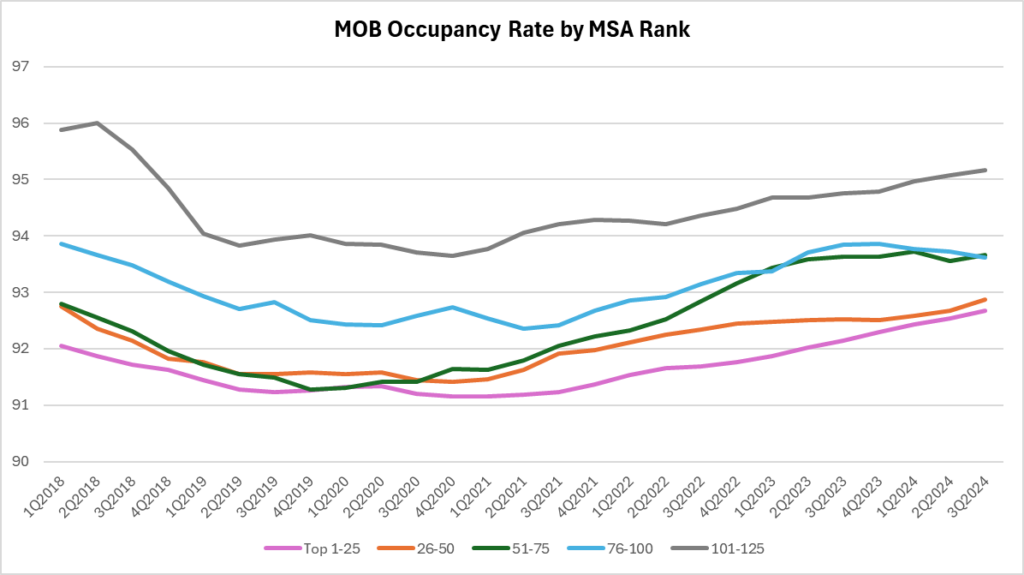
Long-time owners of healthcare properties have recognized this phenomenon for a while – tertiary markets offer high occupancy and high probability of renewal – contrary to conventional investment wisdom in other real property classes.  The average occupancy rate in the Top 100 U.S. metros is at an all-time high of 92.9% in the third quarter of 2024.  However, smaller metros (ranked #101-125) beat this record with occupancy at 95.2%.  Think Fayetteville, Arkansas – #100 on the list – with nearly 600,000 people.  And Salem, Oregon, coming in at #125, with a population of 436,000.  Mighty New York with a metro population of 19.5 million and its Top 25 peers came in at the quintile low occupancy of 92.7%. 

Why?

  • Healthcare is everywhere!  It’s one of the essential services needed by people wherever they live, along with necessities such as groceries, bank, drug store, mobile phone store, etc.
  • Smaller communities are more likely to have purpose built medical, driven by demand from a specific provider.  It is uncommon to have speculative development or overbuilding in small markets, making them more stable investment environments.  From 2019 to today, the number of square feet of MOB completed in the Top 50 metros exceeded absorption by 4.3%.  In the metros ranked 51-125, new supply exceeded absorption by only 1.8%.
  • Medical practices are sticky tenants with high probability of renewal relative to other property classes.  While the stick factor is common throughout the country, small markets have fewer suitable options for relocation.  It is not unusual for a patient to go to the same medical building for care from cradle to grave in a small market.
  • Investment grade health system tenants can be anywhere, and leading specialty or multi-specialty practice groups are as common in small markets as big markets.  With continued consolidation and M&A activity, hospitals in small markets are being gobbled up by major regional players.  Credit quality of the tenant goes up, more clinical support from the acquirer helps to improve access to care and quality for area patients.  As these services grow, it is not uncommon to see development of larger purpose-built Class A MOBs to house an expansion of services.
Mindy Berman
Mindy Berman

Other Articles by Mindy Berman:

    • Update on Health System Medical Outpatient Building Buybacks
    • Health System Transaction Activity: Monetization vs Buybacks
    • 2018 Medical Office Sales Remain at High Level Total – Medical Office Investment Sales

Previous Post:Outpatient Real Estate Sector Riding a Wave of Strength!
Next Post:Inpatient Facility Construction Showed Strength in 2024

Sidebar

Topics

  • Construction/Development
  • Industry News
  • Leasing/Property Management
  • Mergers/Acquisitions
  • Policy/Legislation
  • Real Estate Financing/Capital Markets
  • Revista Best Practices
  • Revista News
  • Sponsor Spotlight
  • Transactions
  • Uncategorized

Archives

RSS Recent Blog Posts

  • Will MOB Financing Continue to Trend Upwards? June 26, 2026
    If you have been following medical office sales activity, you know that transaction volume is moving upwards. Another angle for viewing the financial environment is to look at the number of new mortgages. Looking at the mortgage trend . . . The post Will MOB Financing Continue to Trend Upwards? appeared first on RevistaMed.
    Stephen Lindsey
  • The New York Metro MOB Market is on the Upswing! June 25, 2026
    The New York (NYC) metro medical office market (MOB), which saw its occupancy rate fall as a result of the Covid-19 outbreak, is now on the rebound.  NYC’s MOB market, prior to the pandemic was extremely tight and hovered around 94%. The post The New York Metro MOB Market is on the Upswing! appeared first […]
    Mike Hargrave
  • Are Health Systems Rethinking Their Real Estate Strategy? May 29, 2026
    As health systems face growing pressure to optimize capital and accelerate growth, many are turning to third-party developers and property owners to support their real estate needs. Using Revista’s inventory of medical outpatient buildings (MOB) larger than 7,500 square feet, we examined which health systems are . . . The post Are Health Systems Rethinking […]
    Taryn Harris
  • More MOB Sales in 2026 May 29, 2026
    $16.3 billion in MOBs have traded over the past 12 months. That is the highest level of volume we have recorded since 2Q23. These sales comprised 47 million square feet in MOB buildings, equivalent to 2.9% of . . . The post More MOB Sales in 2026 appeared first on RevistaMed.
    Stephen Lindsey

Other Free Resources

Industry Directory

Search for and/or list your medical real estate services in Revista’s medical real estate directory.

Reports & White Papers

Download free reports & white papers on medical real estate.

Add Lease/Sale Listing

Revista provides free lease/sale listings for healthcare real estate.

Ready to Schedule a Demo?

Get in Touch Now
  • Why Subscribe?
  • Events
  • The MOB Scene
  • Add A Directory Listing
  • Add Lease/Sale Listing
  • Contact Us
  • Sponsorship
  • About
  • Data Terms of Use
  • Sponsorship Terms
  • Press

SIGN UP FOR MOB SCENE NEWSLETTER

  • This field is for validation purposes and should be left unchanged.
  • Twitter
  • Facebook
  • LinkedIn